Business
Tweet Your Way Towards Better Dental Marketing Results

Published
4 months agoon
By
admin
As one of the leading social networking sites nowadays, Twitter is a good way to promote a business. Engagements and search results can be easily achieved. Through a 140-character content, you have the power to expand your business.
Retweets and Likes are mostly the forms of promotions that Twitter uses. But because Twitter uses a different method of curating the content, there is a possibility that new tweets will cover up the tweets, tweeted just minutes ago.
So, as proven time and again, Twitter is a great tool for promoting. But it isn’t a genie’s lamp that would grant you wishes for faster marketing success. Instead, it needs to have great content that is relevant to your audience.
How to use Twitter for your Dental Campaign
Social media is a great way to grow your practice with dental marketing ideas, especially if you’re looking for dental patients. Twitter in particular is a good platform to start with, as it allows you to connect and communicate with your audience in the most direct and effective way.
There are many benefits to using twitter for your dental marketing even if you are not a “techie” or a “geek”.
Here are some of them:
- Twitter provides a fast and effective way to communicate with your target audience.
- You can interact with people who might not know who you are yet. You can build relationships with potential clients.
- Twitter can help you find new customers. Use hashtags to get known by new customers who might be looking for someone exactly like you.
- Twitter helps you stay relevant and up-to-date on current trends and news affecting your industry. You can share important information regarding dental health, dentists, procedures and products with your followers.
- Twitter gives you credibility as an expert by sharing your knowledge and experience with other dental practitioners, patients and potential clients.
Twitter might be a little bird that only allows 140 characters, but if you know how to maximize its use, then you’ll expect better results.
Here are some the tips on using Twitter for your marketing strategy:
Know How to Use the Search Option Properly

A lot of Twitter users don’t know how the search options work and how to properly use the search operators to accurately get the results that they need.
Most people just randomly type keywords in the search box, but what they did not know is that Twitter will only search tweets that have all those words. The results usually show unrelated tweets, to what you intend to find.
However, to obtain better results, users should use the search operator or in between the two keywords that they are searching. And if they are using phrases to search something, it is better to use “” for better results.
From Pinned Tweet to Feature Box
Feature Box is like a lead magnet of your page that allows visitors to add to your email list – it is a form that is on the top of your homepage. You can turn your pinned tweet into a feature box by using lead generation cards and a pinned tweet.
You can create this by only making a Lead Generation Card that includes rewards for people who use or answer the form then pin the tweet to your Twitter profile, then there you have it!
This tool will come in handy in the future when you use it with other marketing tools, and you can directly download your email list with this also.
Tweet the Same Content Many Times but Tweak it a Little
The downside that Twitter has a lot of users is that recent tweets immediately are covered by other tweets. And it results in previous tweets being neglected and becomes useless.
What you can do to maximize the tweeting process to promote this is to tweet the same content a lot of times. Don’t be afraid to do it, because sometimes your second tweet will work better than your first one.
However, even if it is a good idea to tweet the same tweet a couple of times, making the text and image different each time you tweet has a higher risk of receiving tons of interest and engagement. With this also, you can check the analytics of the type of tweets and contents works well.

Your Tweets Should Look Good
Links can be a great help for contents but having long tweets can limit the character count of your tweet. Instead of tweeting the whole link, you can maximize link shorteners. With this, it also makes your tweets neater.
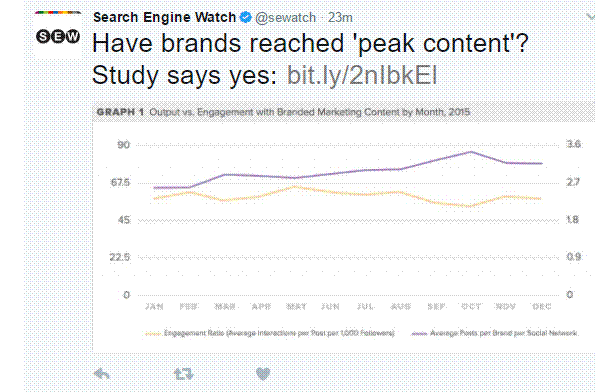
As Twitter keeps on changing, adding videos and images can make a great difference as well because they make your tweets more attractive instead of having dull tweets. Engagements are usually high with this kind of tweets.
Your displayed photo and header should match the business that you have. Make sure that the pictures that you are going to use have high resolutions and fits with the standard sizes that twitter has.
Even your profile bio should be presentable as it is the first thing after your picture that a visitor will look at. Make it short and exciting, like phrases that describe your business or page.
Create a Proper Tweeting Schedule
It may sound so vain, but there are appropriate hours where the engagement is higher compared to other hours of the day. You should properly study the perfect timing, and make scheduled tweets to increase awareness and engagement for your tweets. This way, a lot will be aware of your business.
Takeaway
As social media marketers, using influencer marketing enables us to learn new strategies about social media and how to connect and achieve more engagements. Knowing Twitter’s basics and setting up a profile can help you understand the advances.
You may like
Business
8 Common Mistakes Businesses Make When Adopting SaaS
Published
2 months agoon
November 28, 2025By
admin
Software as a Service (SaaS) has altered the manner in which contemporary businesses are conducted. Whether it is streamlined workflow, lower infrastructure costs, or easy scalability, SaaS tools can considerably increase efficiency when applied properly.
Despite the convenience, a number of businesses falter in the adoption process because of preventable errors. Such wrong moves can easily result in budgetary wastage, agitated employees, and low ROI.
Knowing the most frequent pitfalls can help your business save a considerable amount of time and make sure that your SaaS investment is useful.
Top Major Mistakes Businesses Make When Adopting SaaS
There are several common errors companies make in implementing SaaS; this guide explores eight of them. You will also learn how to prevent them. Keep reading! Among the numerous errors most companies make while implementing the principles of SaaS into their operations, here are eight of them.
Failure to assess the needs of the business appropriately
Most organizations indulge in SaaS adoption merely because a solution is trending or suggested by other businesses. However, unless you evaluate your unique requirements, you can find yourself having features that you are not going to utilize, as well as a platform that is not going to address your actual problems.
Document your workflows before selecting a SaaS solution, notice gaps, and clarify the specific results you wish. This makes sure that the software is suitable for your actual operation requirements.
Disregard of the requirements of integration
The most common mistake is to believe that all SaaS tools will work with your systems. In the event that there is not a good fit between the tools, the data becomes fractured, leading to inefficiency and errors.
Always verify API compliance, integrations it can support, and its ability to fit into your technology stack. A SaaS product must not complicate your workflow; rather, it should improve it.
Undervaluing information protection issues
Pay attention to this! Security is often not given a second thought when it comes to the adoption of SaaS. Businesses believe that the cloud providers take care of all that, but this is seldom so.
You have to assess data encryption, compliance certification, backup policy, and access control. Ensure that the provider addresses your security requirements, particularly when dealing with sensitive or regulated information. Never underestimate information protection.
The inability to train staff adequately
The most potent SaaS tool cannot help at all when the staff is not aware of how to use it. A lot of business organizations implement new software without proper training or orientation.
This leads to resistance, confusion, and poor adoption rates. It should always be accompanied by training sessions, documentation, and internal champions to facilitate the transition. Always prioritize regular staff training, and give them the best.
Failure to assess pricing structures and concealed expenses
The costs of SaaS may be low initially; however, most organizations overlook such things as add-ons, advanced capabilities, storage, upgrades based on user limits, or even long-term subscriptions.
Look into the complete ownership cost before subscribing. Take into account upgrades, scaling requirements, and possible additional charges. An open-price system is a crucial aspect in preventing unexpected costs.
Making decisions without trying out the tool
Companies tend to bypass trial periods and immediately bind themselves, only to realize that the software is not as good as promised.
Never miss a free trial or a demo. Test experience, speed, performance, and key features with actual team members. This practical methodology creates clarity and avoids expensive regrets.
Ignoring change management
The move to SaaS is not merely a technical one, but a cultural one, as well. In case the leadership fails to communicate the rationale behind the change or fails to engage employees in the transition, the outcome will be resistance and slow adoption.
There must be good communication, a rollout plan, and a timetable. The employees should be made to know the benefits of the new tool to both the organization and the employees.
Failure to keep track of performance and ROI post-adoption
Some businesses install SaaS and believe that the work is completed. However, SaaS success requires constant assessment.
You have no idea whether the tool is generating value without measuring usage, performance, metrics, cost effectiveness, or user satisfaction. Periodically audit and obtain feedback to streamline your configuration.
Conclusion
Implementing SaaS can become a revolution in the business, yet it is possible only when taken seriously. With the help of the eight common mistakes that can be avoided above, you will lay the groundwork for a smooth and successful transition.
Go into SaaS with objectives, strategic planning, and evaluation. SaaS, when properly implemented, can increase productivity, automate operations, and provide your team with technology that scales with your business. Finally, you should contact Celesta Tech to help you avoid these mistakes.
Business
Which Business Model Is Most Common for Insurance Companies?
Published
2 months agoon
November 25, 2025By
David Smith
Companies in the insurance industry are built on the assumption and diversification of risk. As a fundamental part of the insurance model, risks from individual payers are pooled and re-distributed. The vast majority of insurance companies generate revenue from two sources: charging premiums for coverage and investing those premiums in other interest-producing assets. A private business, such as an insurance company, aims to maximize its profitability and minimize its overhead.
Aspects of pricing and risk assumption
The revenue models of health insurance companies, jewellery insurance companies, and financial guarantee companies differ. As an insurer, your main responsibility is to price risk and charge you a premium for taking on that risk.
Consider an offer of a $100,000 conditional payout from the insurance company. Based on the length of the policy, the company must assess the likelihood that a prospective buyer will trigger the conditional payment.
An insurance underwriter’s role is crucial in this regard. Insurance companies cannot assume risks properly without a good underwriting process. In the long run, this could cause rates to increase even more by pricing out low-risk customers. It is advised that a company price its risk effectively if it is to bring in more revenue from premiums than it does from conditional payouts.
A claim is really an insurer’s product in a sense. An insurance company must process, verify, and pay claims when a customer files one.
Using this procedure will reduce the risk of loss to the company by excluding fraudulent claims.
Revenue and earnings from interest
If the insurance company receives $1 million in premiums, then it will reveal how much it will have to pay out. Cash or savings accounts are the least efficient ways to hold onto money. At the very least, those savings are at risk of inflation. Rather, it can invest in short-term assets that are safe. While the company waits for possible payouts, it earns additional interest income. Treasury bonds, corporate bonds with high credit ratings and interest-bearing cash equivalents are common instruments of this type.
A reinsurance policy
The purpose of reinsurance is to reduce risk for some companies. As a form of protection against excessive losses, insurance companies buy reinsurance coverage. The purpose of reinsurance is to sustain insurance companies’ solvency and avoid defaults resulting from payouts. Regulators stipulate that certain companies must reinsure.
A company may insure too much for hurricanes if its models predict there will be little damage caused by a hurricane in a particular geographical area. Hurricanes hitting that region could cause significant losses to the insurance company if the inconceivable were to occur. The insurance industry could go out of business if there was no reinsurance to take some of the risks off the table.
Until a policy is reinsured, the government requires insurance companies to cap their policies at 10% of their value. Because reinsurance can transfer risks, insurance companies can compete more aggressively to capture market share. Besides smoothing out insurance company fluctuations, reinsurance eliminates significant net loss and profit variances.
Insurance companies often operate like arbitration companies. When they insure bulk policies, they receive cheaper rates than if they insure individual policies.
Evaluation of insurers
A reinsurance program helps to maintain the stability of the insurance market by smoothing out fluctuations.
Companies in the insurance sector are evaluated based on profitability, growth prospects, payouts, and risk, just as they are for any other non-financial service. However, there are also matters specific to the insurance sector. A small amount of depreciation and a very small capital expenditure are recorded by insurance companies because they do not make investments in fixed assets.
Furthermore, there is no standard working capital account for insurers, making it difficult to calculate their working capital. Analysis focuses on equity indicators, such as price-to-earnings (P/E) and price-to-book (P/B) ratios; firm and enterprise values are not taken into consideration. To assess each company, analysts use insurance-specific ratios computed from the company’s financial statements.
Companies that are expected to grow, pay out high amounts, and have low risk usually have higher P/E ratios. Insurance companies with low risks, high payouts, and high return on equity have higher price-to-book valuations. The biggest impact on the P/B ratio is the return on equity when everything else is constant.
Comparing P/B and P/E ratios across insurance companies may complicate the analysis. It is the responsibility of insurance companies to make provision for future claims. It is possible for this ratio to be too high or too low if the insurer is too conservative or too aggressive in estimating such provisions.
Furthermore, the level of diversification in the insurance sector hinders comparability. The vast majority of insurers engage in one or more distinctive insurance businesses, such as property, casualty, and life insurance. The P/E and P/B ratios of insurance companies differ depending on the degree of diversification each company has.
Business
A Guide To Getting Bankruptcy Off Your Credit Report
Published
2 months agoon
November 24, 2025By
David Smith
How do you feel about the decisions you have made in the past? Could you remove your bankruptcy from your credit report if you knew how? You may have a hard time understanding credit. Here is a simple explanation. Having taken the step to help your credit improve, do you feel ready to continue?
Friends and family members who have experienced bankruptcy have talked to us. Unfortunately, bankruptcy has become more common in modern society. Making credit accessible and straightforward is what we strive for. You can improve your credit and your life by learning how to remove bankruptcy from credit reports.
Here’s what you’ll need
If you have been bankrupt for 7-10 years, your credit report will automatically be cleared of the bankruptcy. Is it possible to remove the bankruptcy earlier?
You have a better chance of being approved for a mortgage, car loan, or other type of credit if you avoid bankruptcy. Any type of loan or credit is difficult to obtain following bankruptcy. You may feel even worse after you declare bankruptcy. The process of removing bankruptcy is long and tedious, but it would be worthwhile to try.
Getting Your Credit Report Removed After Bankruptcy
1. Keep track of your credit score
Your credit score will need to be monitored throughout the entire process. Request your credit reports at the beginning of the process. You can find your credit reports at three credit bureaus in the United States. TransUnion, Experian, and Equifax transcripts are needed. Each agency must provide you with these reports upon request. In the past 12 months, you have been entitled to free credit reports from each of the credit bureaus. It’s possible to collect them all at once or over the course of the year.
It is possible to request online, over the telephone or by mail. For specifics on submitting your request and how to respond in the event it is denied, please consult the government site. You might also consider signing up for an online credit monitoring service to keep track of your credit, so you can plan your next steps.
2. Performing a verification check
The credit bureaus will need to verify whether or not your bankruptcy has been verified. Make the same request to each company separately. I need a letter to be sent to you. The credit bureau must respond within 30 days to any dispute. Remember, the process has already begun, so be patient.
The credit bureau usually responds with a statement stating that the court verification was successful. However, this is rarely the case, but if it is, it is to your advantage. Court verification is not always conducted by credit bureaus.
Be sure to ask who they verified it with in the original letter, so that you can move on to the next step quickly.
3. Get in touch with the courts
Having asked the court the same question now, you will want to contact them. If the court verified your bankruptcy, how did they do that?
Ask to see a written statement if the court says they never verified bankruptcy – as is often the case. For more information, visit bankruptcylawyerinstatenisland.com.
4. Provide the credit bureaus with the courts’ response
With a letter asking for the bankruptcy to be removed, send the court’s statement to the credit bureaus. Identify the claims raised by the bureau that they provided false information in violation of the Fair Credit Reporting Act.
It should be possible to remove bankruptcy if everything goes well.
5. Continue to follow up
Credit bureaus do not guarantee that they will remove the bankruptcy just because they said they would. Watch your credit closely and reach out to a credit expert if nothing changes. Having a professional follow up on your behalf is advantageous, as they will look out for your future credit.
Here are some helpful tips
To remain calm and rational throughout the entire process, at the very least in writing, is crucial. Requests which do not follow the appropriate procedure are shut down by credit bureaus. Stay technical and factual in your letters and don’t show emotion.
Earlier bankruptcy filings are more likely to be removed. Evaluate whether you have time to wait if your bankruptcy was relatively recent. If your initial attempt is rejected, try again after some time has passed. It may only take a couple of years to get their approval instead of ten.
It is important to remember that everyone’s credit situation differs. Despite my best efforts, there may be some scenarios where it does not work. There is no harm in trying.
Final Thoughts
What did you think of my credit report removal tutorial? In an attempt to prevent you from removing bankruptcy, credit bureaus go to great lengths.
Eventually, it will no longer appear on your credit report. However, you can start the process much sooner. I am interested in assisting as many people as I can today who are experiencing bankruptcy. As a professional lawyer, I am able to share my knowledge with you. Helping you get good credit can make life much better for you.
Are you encountering this problem for the first time? Perhaps you’ve tried and failed before or have learned from past mistakes. We would like to hear from you in the comments below.
How Can You Make Your Office Presentations Clear and More Engaging?
Minishortner.com What Is Site Map for SEO? A Detailed Explanation for Website Owners
8 Common Mistakes Businesses Make When Adopting SaaS
7 Tips for Developing Apps for Foldable Smartphones
Types of Deep Learning Networks
All You Need to Know About Digital Marketing
5 Gadgets You Need For An Outdoor Trip
Time to Claim Free 30-Days Trial of Discord Nitro
Which Business Model Is Most Common for Insurance Companies?
How to Take Screenshot on iPhone 11?
Trending
-
Tech2 years agoThe Evolution of Mobile Technology: Past, Present, and Future
-
Gaming4 months agoIs the Forest Cross Platform or Not – Find Out All You Need to Know!!
-
Business3 years agoIs It Beneficial To Learn Business Analytics In 2023?
-
Gaming2 months agoIs Europa Universalis 4 Cross Platform Multiplayer?